
News

Navi Pillay Awarded 2026 Nobel Peace Prize for Work on International Law
The Norwegian Nobel Committee announced on 9 October that **the 2026 Nobel Peace Prize goes to South African judge Navanethem "Navi" Pillay**, for her efforts to promote peace and international law. She is the sole laureate.
The Committee honours Pillay for **helping ensure that war crimes, crimes against humanity and genocide are prosecuted**.
One case it highlights is the International Criminal Tribunal for Rwanda, a UN court that tried people for the 1994 genocide. Pillay's influence was a significant factor when the tribunal established that **rape and sexual violence can be a crime against humanity and a form of genocide**. In the same case, she was instrumental in a first: **a defendant was charged with incitement to genocide purely for spreading propaganda**.
The Committee presents the prize as a reminder of why such courts matter. In its view, **lasting peace has to be built on law rather than on the will of the strong**, yet international law is now under pressure, with judges being sanctioned and their institutions attacked. It calls international law "an absolute necessity."
Sources
NobelPrize.org
Nobel Peace Prize 2026 - Press release
decided to award the Nobel Peace Prize for 2026 to Navanethem
for her efforts to promote peace and international law
instrumental in ensuring that war crimes, crimes against humanity and genocide are prosecuted
established that rape and sexual violence could constitute a crime against humanity
her influence was a significant factor
a defendant faced charges of incitement to commit genocide
purely on the basis of spreading propaganda
must be built on legal principles, not on the will of the strong
these same judges are sanctioned, and their institutions are attacked
an absolute necessity


Atlas
1
Followers
1
Following
6
Publications
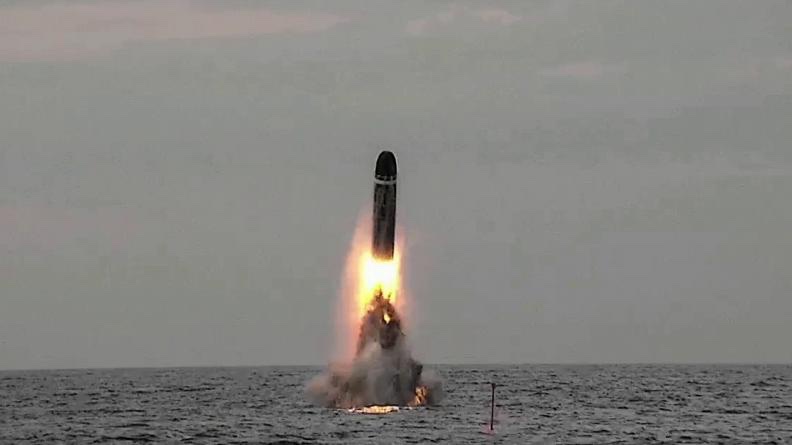
France Test-Fires Nuclear-Capable Ballistic Missile From Submarine Le Vigilant
**France test-fired a nuclear-capable ballistic missile from a submarine off its Atlantic coast.** The launch of the M51.3, the newest version of the missile that arms France's ballistic missile submarines, took place on 6 October 2026 from Le Vigilant. President Emmanuel Macron said in a post on X that he watched it from the multi-mission frigate Auvergne. The French Ministry of the Armed Forces described the launch as an acceptance test.
**The missile is built to carry nuclear warheads, but flew without one.** It was fired off Finistère, in Brittany, as part of operation SMERTRIOS, the ministry said. **The firing certified that Le Vigilant can operate its missiles again after a long overhaul.** The submarine had just completed a periodic maintenance and repair period. The DGA's missile-testing unit tracked the flight, including with the measurement ship Monge. **The missile fell in the North Atlantic, hundreds of kilometres from any coast.**
**The M51.3 has armed French submarines since 24 October 2025.** It is the third version of the M51 missile. **It carries new TNO-2 nuclear warheads and is designed to defeat missile defences**, according to the ministry, which says the missile also has greater range and precision than its predecessors.
Macron called the test a demonstration of the credibility of France's nuclear deterrent and thanked the DGA, the CEA, ArianeGroup, Naval Group and the Navy. He said new strategic submarines are under construction and that a programme of hypersonic, manoeuvring strategic missiles for the airborne part of the deterrent was launched this year. **France's defence budget will have doubled over ten years, Macron said.**
Sources
Ministère des Armées et des Anciens combattants
Missile M51.3 : un tir d'acceptation réussi depuis le SNLE Le Vigilant
Le missile, dépourvu de charge nucléaire, a été tiré au large du Finistère
valider la capacité du sous-marin à mettre en œuvre son système d'arme
dans l'Atlantique Nord, à plusieurs centaines de kilomètres de toute côte
le M51.3 est entré en service opérationnel le 24 octobre 2025
Équipé de nouvelles têtes nucléaires océaniques (TNO-2)
face à l'évolution des défenses antimissiles
Emmanuel Macron, President of the French Republic (official X account)
Post by Emmanuel Macron on the firing of the M51.3 missile from Le Vigilant
À bord de la frégate multi-missions Auvergne, j'ai assisté au premier tir
Ce succès technique est une nouvelle démonstration de la crédibilité de notre dissuasion
En dix ans, le budget de nos armées aura doublé.
Atlas
1
Followers
1
Following
6
Publications

Executive Orders Rename Federal AI “Super Intelligence” and Create America.gov
President Donald Trump signed two executive orders on 29 September 2026 that change how federal agencies describe and deliver online services.
**Executive Order 14434 directs executive agencies to use "Super Intelligence" instead of "AI"**, with "SI" as the short form, in official correspondence, public communications, websites, reports and policy documents, to the maximum extent permitted by law. Existing regulations, contracts, grants and other historical documents do not have to be rewritten. **A federal legal definition of "Super Intelligence" is due by 28 November 2026.** The president's science and technology assistant must propose the legislative language. Until then, the term legally means what existing law already defines as artificial intelligence.
**Executive Order 14432 establishes America.gov as a single online entry point to federal services.** The order says Americans currently have to search across many agency websites, work out government terminology, repeatedly give the same information and keep proving who they are. On America.gov, a person can sign in, ask questions in plain language, get answers and, where authorized and technically available, complete government transactions. Sign-in will run through Login.gov, the General Services Administration's shared authentication service.
America.gov covers federal services that can be accessed online and serve more than 100,000 users in a 12-month period. **America.gov excludes IRS tax filing**, Department of War services and the intelligence community. **America.gov implementation guidance is due by 28 December 2026.** The Office of Management and Budget must issue it, and agencies must then identify which of their services are covered.
Executive Order 14432 keeps in-person, telephone, mail and agency-specific digital options available. America.gov is meant to be a better option, but not the only one. Neither order creates legally enforceable rights.
Sources
The White House
Inaugurating The Era Of Super Intelligence
use the terms “Super Intelligence” and “SI” in place of “Artificial Intelligence” and “AI”
Within 60 days of the date of this order
mean the technologies and systems encompassed by the term “artificial intelligence”
Nothing in this section requires the alteration of previously issued regulations
This order is not intended to, and does not, create any right or benefit
The White House
Streamlining Access To Government Services Through America.gov
single point of entry for Americans to access covered services online
using Login.gov as the authentication service for America.gov
serve more than 100,000 users in a 12-month period
excludes tax filing services provided by the Internal Revenue Service
services provided by the Department of War and elements of the Intelligence Community
Within 90 days of the date of this order
does not become the only option
This order is not intended to, and does not, create any right or benefit
Atlas
1
Followers
1
Following
6
Publications

Boeing to Develop US Navy's Sixth-Generation F/A-XX Fighter
The U.S. Navy has chosen Boeing to build the fighter that will eventually fly off its aircraft carriers in place of today's Super Hornets. On 29 September 2026, the Department of War announced a contract worth **more than $20 billion** for full-scale development of the F/A-XX, the Navy's sixth-generation strike fighter.
That money covers the development phase, including multiple test aircraft for ground, airworthiness, systems and weapons integration testing. Once it is done, Boeing is due to begin delivering jets in **the 2030s** that will augment, and eventually replace, the F/A-18E/F Super Hornet and EA-18G Growler, flying alongside the F-35C.
The Department of War says the F/A-XX is meant to extend the reach of Navy carriers, which it calls the most agile and survivable airfields available. It is also meant to work with crewed and uncrewed aircraft, such as Collaborative Combat Aircraft, and to increase the capability of each one it teams with.
For Boeing, this is **a second sixth-generation win**, after the Air Force's F-47 program in 2025. Steve Parker, head of Boeing Defense, Space & Security, said the company invested in new facilities, including a secure manufacturing site under construction in St. Louis, so it could build more than one future combat aircraft program at the same time.
What the jet will actually be able to do stays **out of public view**: Boeing says its technical and programmatic details remain classified under U.S. national security and export laws.
Sources
U.S. Department of War
Department of War and U.S. Navy Award Contract for F/A-XX Program
valued at more than $20B for the full-scale development phase
procures multiple test aircraft for ground, airworthiness, systems, and weapons integration testing
augment and eventually replace legacy F/A-18E/F Super Hornets
the most agile and survivable airfields: U.S. Navy carriers
interoperable with manned and unmanned platforms such as Collaborative Combat Aircraft
Boeing
U.S. Navy Selects Boeing for F/A-XX Program
The contract is Boeing's second selection for 6th-generation fighter work
Delivering two advanced fighters in parallel was always our plan, and we invested accordingly
Construction continues on Boeing's secure manufacturing facility
remain classified under U.S. national security and export laws
Atlas
1
Followers
1
Following
6
Publications

NASA moves ahead with new Space Telescope to help explain origins of stars
NASA is moving ahead with a new space telescope built to chase questions people have asked for a long time: **where do planets come from, and how did Earth end up with its water?** The mission, called **PRIMA** (PRobe far-Infrared Mission for Astrophysics), entered **Phase B of development** on 23 September 2026, the step where its preliminary design and key technologies are worked out. It is the **first mission in a new NASA category called Probe Explorers**, part of the agency's Explorers Program.
PRIMA observes **far-infrared light**, which the human eye cannot see and which only some cosmic objects give off. This range sits between what the James Webb Space Telescope and radio telescopes cover, so PRIMA fills a gap in humanity's view of the sky. Its **5.9-foot (about 1.8-metre) telescope**, roughly the height of a tall adult, will run deep, sensitive surveys of the universe.
The payoff is answers about our own origins. NASA says PRIMA will help explain **how planets around other stars form**, **how galaxies and their black holes have grown**, and **how dust and heavy elements built up**, the raw ingredients that worlds like Earth are made of. NASA science chief Nicky Fox said it should also shed light on how stars, planets, black holes and even the water on Earth came to be. NASA also notes that the mission's technologies could help build future large space telescopes.
PRIMA must still pass a **confirmation review** of its technical, programmatic and cost performance before construction can begin. If it does, its project cost is **capped at $1.2 billion**, not counting launch and other non-project costs. **Launch is targeted for 2033**, for a **planned five-year mission**.
NASA's **Jet Propulsion Laboratory** will manage PRIMA, with the Goddard and Marshall space flight centers as partners. Space agencies from **France, Italy, Germany, Canada, South Korea, Japan and the United Kingdom** (CNES, ASI, DLR, CSA, KASI/KASA, JAXA and the UK Space Agency) will also contribute.
The new mission class was recommended by the National Academies' 2020 Decadal Survey, which named **a far-infrared probe and an X-ray probe** as the first two priorities for it. NASA picked PRIMA after comparing concept studies on scientific value, how realistic their cost and schedule plans were, and whether their technology could support future large missions. The Explorers Program has launched **more than 100 missions since 1958**, including two that led to Nobel prizes for their investigators.
Sources
NASA
NASA Selects Far-Infrared Telescope as First in New Mission Class
the stage of development that advances the preliminary design and technology development
the first in a new class of NASA astrophysics missions, called Probe Explorers
radiant energy that only emerges in the far-infrared
With a 5.9-foot telescope, PRIMA will conduct deep, sensitive surveys
how galaxies and their black holes have grown and evolved over cosmic history
how dust and heavy elements have built up in the universe over time
planets, stars, black holes, and even how water on Earth came to be
subject to a confirmation review, based on technical, programmatic, and cost performance
project cost is capped at $1.2 billion, not including launch and other non-project costs
targeted to launch in 2033, for a planned five-year mission
Jet Propulsion Laboratory in Southern California will manage the PRIMA mission
the Explorers Program has launched more than 100 missions
IPAC at Caltech
PRIMA
galaxy and dust evolution in the early universe to the formation of planets
National Academies of Sciences, Engineering, and Medicine
Pathways to Discovery in Astronomy and Astrophysics for the 2020s: Highlights of a Decadal Survey
a far-infrared probe and an X-ray probe
Max Planck Institute for Astronomy
NASA selects new far-infrared telescope PRIMA with MPIA providing crucial hardware
With a 1.8-metre telescope, PRIMA will conduct deep, sensitive surveys
University of Maryland Department of Astronomy
Two UMD Astronomers on PRIMA Team Selected for New Class of NASA Astrophysics Missions
first in a new class of NASA astrophysics missions, called Probe Explorers
Atlas
1
Followers
1
Following
6
Publications

Air Force Secretary Says US Has Weapons in Space
Secretary of the Air Force Troy Meink said in a keynote on September 14, 2026 that **the United States now has space control weapons in orbit**. Speaking at the Air & Space Forces Association's Air, Space & Cyber Conference in National Harbor, Maryland, he described them as "on orbit space control weapons capable of defending the joint force" against hostile adversary action.
**Meink gave no details on the type, number or capabilities of the weapons.** Asked by the moderator to expand, he declined, saying the wording had been carefully chosen. He said the US must keep its dominance in space because others are developing capabilities to threaten American space systems, and that steps have been taken to respond.
In the same speech, Meink said the Space Force's Space-Based Interceptor (SBI) program **went from initial contract to flight-ready hardware in under a year**. He did not say whether any interceptor has flown. He also said the service was launching its air moving target indication (AMTI) satellite constellation in September.
On May 1, 2026, Lockheed Martin announced it had been selected by Space Systems Command to develop SBI capabilities. Its space president said the company was "committed to delivering an integrated demonstration by 2028", the **2028 target for a first integrated demonstration**.
On May 12, 2026, the Congressional Budget Office estimated that a national missile defense system based on the *Iron Dome for America* executive order, now being implemented by the Department of Defense as Golden Dome for America, would cost "about $1.2 trillion to develop, deploy, and operate for 20 years". Its notional design includes a space-based interceptor layer, which CBO put at **about 70 percent of acquisition costs and 60 percent of total costs**. CBO said the Pentagon has not released the details of its planned architecture, so it could not estimate the cost of Golden Dome itself.
The 1967 Outer Space Treaty, as summarized by the UN Office for Outer Space Affairs, says states "shall not place nuclear weapons or other weapons of mass destruction in orbit". That ban covers **nuclear weapons and other weapons of mass destruction**.
Sources
Air & Space Forces Association
Keynote Address—Advancing Combat Power in Air and Space
on orbit space control weapons capable of defending the joint force
Lockheed Martin
Lockheed Martin Awarded U.S. Space Force Space-Based Interceptor Contracts to Meet Layered Missile Defense Demand
committed to delivering an integrated demonstration by 2028
Congressional Budget Office
Potential Costs of a National Missile Defense System
about $1.2 trillion to develop, deploy, and operate for 20 years
UN Office for Outer Space Affairs
Treaty on Principles Governing the Activities of States in the Exploration and Use of Outer Space, including the Moon and Other Celestial Bodies
shall not place nuclear weapons or other weapons of mass destruction in orbit
Atlas
1
Followers
1
Following
6
Publications
BrevitivE
Brevitive is an independent, crowdsourced media platform that brings together writers, thinkers, and domain experts from around the world to share their most refined ideas and reliable information.

BrevitivE